Foam removal and resealing
Builder's foam fills a gap and looks finished. In a fire it does not hold. This is what happens to it.
- Every seal labelled and photographed
- BM TRADA / FIRAS-certificated contractors
- Written price before any work
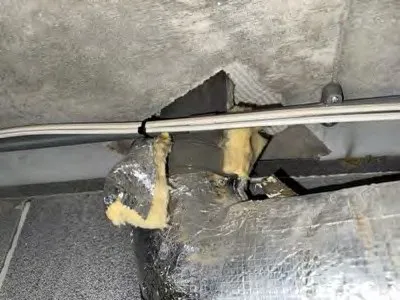
The second photo on our home page, repeated here, shows a foil-lagged duct running under a concrete slab with yellow expanding foam pushed into the gaps round it. It is one of the most common things a fire stopping survey turns up. Someone needed to close a gap, had a can of foam in the van, and filled it.
General-purpose expanding foam is an insulation and gap-filling product, and it is not made to hold back a fire. Fire rated foams do exist, usually pink, red or grey, and some have been tested for particular joints and sizes. But the colour does not prove anything on its own, and unless the product can be identified and matched to a test for that wall and that gap, a surveyor will record the gap as open.
Taking it out
Our contractors cut the foam back to the face of the wall or slab and pull out as much as comes away, so the new seal can bond to the substrate rather than to foam. Round a lagged duct like the one in the photo, the lagging itself has to be looked at as well, because some lagging carries fire along the duct and the seal has to be one that is tested with that lagging in place. Where the gap has been made bigger by careless cutting in the past, the new seal is sized to what is there now, not to what the hole was meant to be.
How much foam is too much
It is rare for there to be only one patch. If the first riser cupboard has foam in it, the others probably do too, which is why a fire stopping survey of the whole building is usually cheaper in the end than fixing the patches as they are noticed.
Foam removal and resealing is carried out by our BM TRADA / FIRAS-certificated contractors.
Send a photo with a tape measure across it, the postcode and the type of building. We tell you what it needs and what it is likely to cost.